About 125 minutes
The Christian Mythology — Context and Discussion
Theology
28,738 recorded words. 7 minutes difference from this book's estimate.
View Gutenberg source #52414
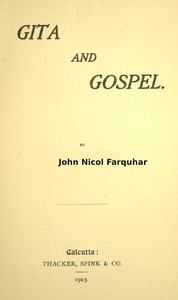
The source record for Gita and gospel — Reading Companion measures this digital text at 30,139 words, 2 hr 12 min estimated reading time, and 10 detected text sections.
The text analysis averages about 18.9 words per sentence, while the detected sections provide another way to judge how the source is divided.
Project Gutenberg metadata also associates the work with “Christianity and other religions -- Hinduism,” connecting these edition facts with the source record’s subject description.
Explore this collection
These alternatives are selected using recorded categories and estimated reading time.
About 125 minutes
Theology
28,738 recorded words. 7 minutes difference from this book's estimate.
View Gutenberg source #52414About 140 minutes
Theology
32,035 recorded words. 8 minutes difference from this book's estimate.
View Gutenberg source #52714About 154 minutes
Theology
35,370 recorded words. 22 minutes difference from this book's estimate.
View Gutenberg source #28104Search stored excerpts and compare books → Choose by your preferences →
Choices use stored catalog measurements. Estimates vary with reading speed. A shared category is a catalog label, not a claim that two books have the same argument or literary quality.
Search reads excerpt text stored with this catalog and links to its associated Gutenberg record. The connection is stored in the site database; this tool does not recheck that every excerpt is word-for-word identical to that external record. Excerpt search does not cover every chapter and does not verify historical publication dates.
Catalog snapshot checked: 2026-09-25. Coverage: 94 public books, 94 available source excerpts.
Read the complete public-domain text at its original source.
Read on Project GutenbergThe opening chapter of Gita and Gospel immediately establishes a comparative framework by describing the Bhagavadgītā as a work that is simultaneously philosophical, devotional, and dramatic—a poem that draws inspiration from speculative systems while remaining fresh and readable. The author, writing under the pseudonym Neil Alexander, adopts a scholarly yet engaged tone, weaving together observations about the Gītā's influence on educated India and its paradoxical combination of atheistic metaphysics with reverent adoration. This initial characterization sets the stage for a sustained comparison with Christian scriptures, particularly the Passion narratives from St. Matthew's Gospel.
The author presents the Bhagavadgītā as a text of deliberate contradictions: a philosophical work that is also poetry, a book of devotion rooted in speculative systems, and a dramatic scene set within a battle yet filled with scholastic leisure. This description foregrounds the Gītā's layered voice, which shifts between metaphysical argument and lyrical devotion. The text's ability to hold these tensions together is presented as a key to its enduring appeal. The author does not resolve these contradictions but instead uses them to frame the Gītā as a unique literary artifact, one that demands attention precisely because of its hybrid nature.
In the later portion of the excerpt, the author juxtaposes the Gospel account of Jesus's trial and crucifixion with a quotation from Plato's Republic about the fate of the just man. The rhetorical strategy is one of direct comparison: the Gospel passages are quoted at length, followed by Plato's prediction, and then the author insists on the correspondence between the two. The pacing here shifts from the analytical tone of the earlier chapter to a more urgent, almost homiletic style. The author uses repetition and parallel phrasing—'How was it that…?' and 'How can we reconcile…?'—to drive home the argument that the suffering of Jesus was both foreseen and inevitable. This section demonstrates a clear change in pace from the measured exposition of the Gītā's qualities to a passionate, almost dramatic recounting of the Passion.
The final part of the excerpt moves from historical comparison to a broader theological claim: that the opposition Jesus faced is a universal struggle between sinful human nature and divine holiness. The author extends this pattern to the Roman persecutions and to every land where Christianity goes, suggesting a recurring conflict. This shift from specific textual analysis to general principle marks another change in pace and voice. The language becomes more abstract and universalizing, moving away from the concrete details of the Gospel narrative. The author's own voice becomes more pronounced, offering an interpretation that frames the Passion not as a unique historical event but as a paradigm for ongoing spiritual conflict.
Readers approaching Gita and Gospel should attend to the author's method of alternating between close textual analysis and broader comparative claims. The work's argument unfolds through shifts in pace and voice—from scholarly exposition to dramatic quotation to universal application. Noting these transitions will clarify how the author builds his case for the parallels between the Gītā and the Gospel, and how he uses each text to illuminate the other.
I’d never quite noticed how the Gītā and the Gospels both build their power through voice and silence, Krishna speaking at the edge of battle, Jesus resting inside the tomb. That quiet between words stayed with me long after closing the companion. It made me think of the stillness in "He was buried." A Sermon for Easter Even — Text and Context, where even Scripture holds its breath.
Your answers remain private and are stored only in this browser.









