
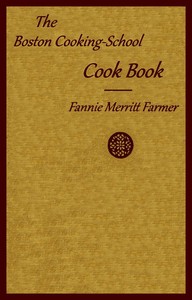
The Boston cooking-school cook book by Fannie Merritt Farmer
Let's be clear: this isn't a novel. There's no plot twist on page 200. But the story it tells is the quiet revolution of the American kitchen. Published in 1896, Fannie Farmer was recovering from a illness that halted her formal education. She turned her brilliant, organized mind to cooking. At the time, recipes were vague heirlooms passed down with instructions like 'butter the size of a walnut.' Farmer changed all that. Her book insisted on level measurements—the cup and spoon system we use today. She presented cooking as a teachable science, not just magic.
Why You Should Read It
I love this book because it has a voice. It's firm, confident, and wants you to succeed. Reading a recipe for 'Graham Muffins' or 'Boiled Cod' feels like a direct conversation with a very smart, practical teacher from another century. You get glimpses of her world: instructions for making a 'Nourishing Drink for the Sick' or setting a proper table for a formal dinner. It's a snapshot of life, food, and gender roles at the turn of the 20th century. It makes you appreciate the sheer work that went into feeding a family before modern conveniences.
Final Verdict
This is for the curious cook, the history lover, or anyone who enjoys a tangible link to the past. It's perfect for someone who thumbs through vintage books at flea markets and wonders about the lives they've lived. Don't buy it expecting glossy photos or quinoa recipes. Buy it to meet Fannie Farmer, to understand a foundation of American food culture, and to maybe, just maybe, bake a perfect batch of her 'Ginger Snaps.' They still hold up.
You are viewing a work that belongs to the global public domain. Share knowledge freely with the world.
Robert Thompson
6 months agoIt effectively synthesizes complex ideas into a coherent whole.
Susan Hernandez
1 year agoThe digital formatting makes it very easy to navigate.
James White
7 months agoThe layout of the digital version made it easy to start immediately, the clarity of the writing makes even the most dense sections readable. Well worth the time invested in reading it.
Karen Davis
1 month agoExactly what I was looking for, thanks!





Margaret Wilson
5 months agoLooking at the bibliography alone, the visual layout and supporting data make the reading experience very smooth. I'm glad I chose this over the other alternatives.