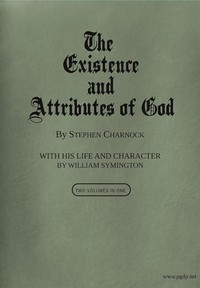
Stephen Charnock's The Existence and Attributes of God opens with a discourse on Psalm 14:1, immediately establishing a pattern of anchoring each attribute in a specific scriptural text. The work proceeds through eight discourses, each treating a divine attribute—spirit, eternity, immutability, omnipresence, knowledge, and wisdom—with a consistent structure: exposition of the doctrine, confirmation by reason and scripture, and practical applications. The excerpt on God's wisdom exemplifies this method, moving from the proposition that God's wisdom is infinite to three 'uses'—reproof, comfort, and direction—each developed with concrete analogies (physician, lawyer) and direct address to the reader's experience of distrust or affliction.
Structure of the Discourses
Each discourse follows a recognizable pattern: a scriptural text is cited, its terms are defined, and the attribute is argued from reason and scripture. The excerpt on wisdom, for instance, begins by asserting God's infinite wisdom, then addresses unbelief as a contradiction to that wisdom, and concludes with three 'uses'—reproof, comfort, and direction. This tripartite structure (doctrine, confirmation, application) recurs throughout, giving the work a homiletic rhythm. The applications are notably concrete: Charnock compares God's timing of afflictions to a physician's skill, and he rebukes readers for trusting human experts while distrusting God. The discourse on wisdom also includes a cross-reference to an earlier treatment of unbelief, indicating that the discourses were designed as a connected series.
Pastoral Tone Amid Doctrinal Rigor
Despite its systematic scope, the work frequently adopts a pastoral tone. In the wisdom discourse, Charnock writes directly to the reader's experience: 'If he be wise to dispose of us, why do we distrust him?' He uses analogies from everyday life—physicians, lawyers, estates—to make theological points accessible. The 'use of comfort' section is particularly personal, assuring readers that God's wisdom is 'exact in managing' and that 'nothing is done by him too soon or too slow.' This blend of doctrinal precision and pastoral concern suggests that Charnock intended the work not merely as a theological treatise but as a guide for devotion and practical faith.
Recurring Imagery and Argumentative Patterns
Charnock frequently employs medical imagery: God is a 'skilful physician' who 'prescribes bitter potions' and 'cheering cordials' according to the malady. This metaphor recurs across discourses, reinforcing the idea that divine action is both purposeful and benevolent. Another pattern is the use of rhetorical questions to engage the reader: 'Why do we distrust him? If we distrust him, why do we embrace an opinion of wisdom?' These questions serve to expose logical inconsistencies in human behavior. The text also shows a habit of listing parallel examples—'We trust the physician’s skill... and the lawyer’s counsel; but are loath to rely upon God'—to drive home the contrast between human and divine trustworthiness.
Readers approaching this work should expect a demanding but rewarding experience. The discourses are dense with scriptural citation and logical argument, yet they reward careful reading with moments of striking pastoral insight. Charnock's method—moving from doctrine to application—invites the reader to reflect on how each attribute of God shapes daily life and faith. The work is best read slowly, perhaps one discourse at a time, allowing the interplay of reason, scripture, and personal address to unfold.
I keep thinking about that old Charnock volume, how it weighed on me gently—God’s eternity felt less like a doctrine and more like a quiet room. And that reminded me of another familiar companion, Expositions of Holy Scripture Ezekiel, Daniel, and the Minor Prophets. St. Matthew Chapters I to VIII — Text and Context, where prophecy feels like slow breathing. Both left me holding something tender, long after the pages closed.