About 301 minutes
Parochial and Plain Sermons, Vol. VII (of 8) — Story, Setting & Ideas
Theology
69,161 recorded words. 6 minutes difference from this book's estimate.
View Gutenberg source #24256
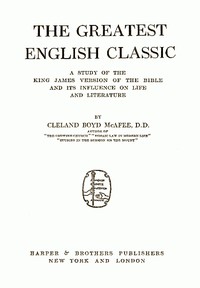
Before opening The Greatest English Classic A Study of the King James Version of the Bible and Its Influence on Life and Literature — Reading Companion, the edition data offers a quick orientation: 67,639 words, 4 hr 55 min estimated reading time, and 7 detected text sections.
The text analysis averages about 21.1 words per sentence, while the detected sections provide another way to judge how the source is divided.
Project Gutenberg metadata also associates the work with “Bible -- History,” connecting these edition facts with the source record’s subject description.
Explore this collection
These alternatives are selected using recorded categories and estimated reading time.
About 301 minutes
Theology
69,161 recorded words. 6 minutes difference from this book's estimate.
View Gutenberg source #24256About 284 minutes
Theology
65,166 recorded words. 11 minutes difference from this book's estimate.
View Gutenberg source #13166About 315 minutes
Theology
72,333 recorded words. 20 minutes difference from this book's estimate.
View Gutenberg source #24284Search stored excerpts and compare books → Choose by your preferences →
Choices use stored catalog measurements. Estimates vary with reading speed. A shared category is a catalog label, not a claim that two books have the same argument or literary quality.
Search reads excerpt text stored with this catalog and links to its associated Gutenberg record. The connection is stored in the site database; this tool does not recheck that every excerpt is word-for-word identical to that external record. Excerpt search does not cover every chapter and does not verify historical publication dates.
Catalog snapshot checked: 2026-09-25. Coverage: 94 public books, 94 available source excerpts.
Read the complete public-domain text at its original source.
Read on Project GutenbergCleland Boyd McAfee opens his 1912 lectures by distinguishing the three great Book-religions—Judaism, Christianity, and Mohammedanism—noting that only the Koran forbids translation, whereas the English Bible has been repeatedly rendered into the vernacular. This contrast sets the stage for a study that treats the King James Version not as a sacred artifact but as a literary and historical force. McAfee, a Presbyterian minister and author of works on church growth and biblical law, delivered these six talks at the Brooklyn Institute of Arts and Sciences, prompted by the tercentenary of the 1611 translation. The lectures move from the pre-King James English Bibles through the making of the Authorized Version, its literary qualities, its influence on English literature and history, and finally its place in contemporary life.
McAfee devotes his first lecture to the English Bibles that preceded the King James Version, emphasizing that the 1611 translators did not work in a vacuum. He traces a lineage from Wycliffe through Tyndale, Coverdale, and the Geneva Bible, each contributing language and phrasing that the King James revisers would adopt and refine. The preface notes that the lectures were “suggested by the tercentenary,” and McAfee’s method is historical rather than devotional: he treats the earlier versions as stages in a literary evolution. He observes that the Geneva Bible, favored by Puritans, had marginal notes that sometimes challenged royal authority, a detail that hints at the political pressures surrounding the new translation. By grounding the King James Version in this lineage, McAfee argues that its success was not sudden but the culmination of a century of English biblical prose.
In his lectures on literary influence, McAfee selects six Jacobean and five Georgian writers to demonstrate the Bible’s shaping power. He notes that Shakespeare, Milton, Bunyan, Dryden, Addison, and Pope all “are at their best under the power of the Bible.” For Pope, McAfee points to The Messiah as a poem that “outlines the movement of Scripture” and to the line “Rise, crowned with light, imperial Salem, rise” as evidence of biblical phrasing in Pope’s work. He is careful to distinguish literary influence from moral endorsement: he sharply criticizes Shelley and Byron for their personal conduct, insisting that “there are not two moral laws, one for geniuses and one for common people.” This moral frankness is a recurring pattern in McAfee’s approach—he admires the Bible’s stylistic impact without conflating it with the lives of its users.
McAfee draws a telling contrast between the Koran and the Bible: the Koran’s Arabic is considered untranslatable, while the Bible has been rendered into many languages, each claiming authority. This comparison, made in the opening lecture, frames the King James Version as a translation that achieved a kind of literary supremacy without claiming linguistic inerrancy. McAfee returns to this tension when discussing the Bible’s place in modern life, arguing that its authority is moral and literary, not magical. He also notes that the King James translators worked under royal mandate but produced a version that transcended its political origins. The recurring pattern of contrast—between sacred and vernacular, between literary merit and personal morality, between historical contingency and enduring influence—gives the lectures a dialectical structure that rewards careful reading.
McAfee’s lectures are best read as a series of connected arguments rather than a comprehensive history. Readers interested in the textual details of the 1611 translation may want to supplement this with more recent scholarship, but McAfee’s focus on the Bible’s literary afterlives remains valuable. His willingness to name specific authors and passages—and to judge their moral failings—gives the work a directness that later academic studies often avoid. The lectures were delivered in 1912, and their occasional references to contemporary debates remind us that the King James Version was, for McAfee, a living book, not a museum piece.
I finished McAfee's lectures feeling like I’d been given a quiet tour through history, watching how those old words shaped lives I never knew were connected. It made me think of something similar in weight, though older still — The World's Great Sermons, Volume 01: Basil to Calvin — Story, Setting & Ideas — and how these voices, so far apart, still feel like they’re speaking to the same restless part of us.
Save your reaction, strongest insight, and memorable passage.









