About 95 minutes
Five Sermons — Themes and Context
Theology
21,837 recorded words. 12 minutes difference from this book's estimate.
View Gutenberg source #8731
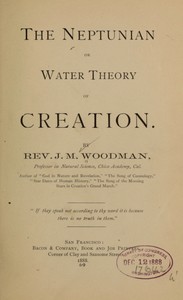
The catalog record for The Neptunian, or Water Theory of Creation — Inside the Classic provides practical reading context through 24,581 words, 1 hr 47 min estimated reading time, and 7 detected text sections.
The text analysis averages about 18.5 words per sentence, while the detected sections provide another way to judge how the source is divided.
Project Gutenberg metadata also associates the work with “Religion and science,” connecting these edition facts with the source record’s subject description.
Explore this collection
These alternatives are selected using recorded categories and estimated reading time.
About 95 minutes
Theology
21,837 recorded words. 12 minutes difference from this book's estimate.
View Gutenberg source #8731About 91 minutes
Theology
20,907 recorded words. 16 minutes difference from this book's estimate.
View Gutenberg source #39290About 125 minutes
Theology
28,738 recorded words. 18 minutes difference from this book's estimate.
View Gutenberg source #52414Search stored excerpts and compare books → Choose by your preferences →
Choices use stored catalog measurements. Estimates vary with reading speed. A shared category is a catalog label, not a claim that two books have the same argument or literary quality.
Search reads excerpt text stored with this catalog and links to its associated Gutenberg record. The connection is stored in the site database; this tool does not recheck that every excerpt is word-for-word identical to that external record. Excerpt search does not cover every chapter and does not verify historical publication dates.
Catalog snapshot checked: 2026-09-25. Coverage: 94 public books, 94 available source excerpts.
Read the complete public-domain text at its original source.
Read on Project GutenbergWoodman’s The Neptunian, or Water Theory of Creation opens with a table of contents that immediately signals its dual ambition: to review three theories of creation—Plutonic, Neptunian, and a third—and to ground the Neptunian view in the Book of Job. The author, a professor of natural science at Chico Academy, California, positions himself as a reconciler of scripture and science, but the excerpts show a work more invested in allegorical reading than empirical geology. The catalog subjects—Religion and science, Creation, Bible and science—accurately reflect the book’s scope, but the actual text leans heavily on a prophetic-dramatic interpretation of Job, treating its characters as representatives of historical forces (e.g., Elihu as “Secular Education”). This editorial note examines how the catalog categories relate to the work’s actual content.
The catalog lists “Religion and science” as a subject, but Woodman’s method is not to reconcile empirical findings with scripture in a straightforward way. Instead, he reads scientific phenomena as objective truths that prophecy has already “poetized.” For instance, he interprets the biblical “place for light” and “home for darkness” as describing a pole of the Earth pointing steadily at the sun, leaving half the globe dark. This is not a claim about geology but about the predictive power of poetic language. Similarly, Joshua’s long day is explained as a mirage—a naturalistic reading that still upholds the biblical account. The science here is not laboratory-based but hermeneutic: Woodman treats Job as a cosmological textbook written in figurative speech.
Despite the title, the excerpts devote more space to interpreting Job than to outlining the water theory itself. The table of contents promises sections on how “rock can swim in water” and “water raised the mountains,” but the available text focuses on the drama of Job’s friends as representatives of theological errors. Bildad, Elihu, and Job embody three views of prayer: Bildad’s miracle-demanding faith, Elihu’s deistic denial of prayer’s efficacy, and Job’s middle position that prayer works within God’s laws. This allegorical framework is Woodman’s primary method. The “Neptunian” label seems to serve as a banner for a broader argument that scripture, rightly interpreted, anticipates modern science—a claim that the catalog subject “Bible and science” captures only partially.
Woodman’s references to contemporary figures—Sir Charles Lyell, French Atheists of 1808—anchor his work in the late-1800s debate over biblical authority. He cites Lyell’s admission that science had abandoned 83 anti-Bible counts, using this as evidence that scripture is vindicated. Yet the excerpts show no engagement with Lyell’s actual geology; the argument is rhetorical, not empirical. The catalog’s “Creation” subject is thus treated as a theological battlefield, not a scientific one. Readers expecting a geological treatise will find instead a homiletic commentary on Job, with science invoked as a supporting witness. The book’s value lies in documenting how one American clergyman tried to harmonize his faith with the science of his day, using allegory as his primary tool.
Woodman’s work is best approached as a period piece of American religious thought, not as a contribution to geology. Readers interested in 19th-century attempts to reconcile science and scripture will find a distinctive voice—one that treats Job as a star-dated prophecy and geological theories as secondary to spiritual interpretation. The catalog subjects are accurate but incomplete; the book’s heart is exegetical, not empirical.
That old treatise made me sit with water as a quiet, patient force—less dramatic than fire, yet somehow more stubborn. It reminded me of a friend’s gentle insistence on scripture’s voice in science. That same unhurried reverence echoes in Inspiration and Interpretation Seven Sermons Preached Before the University of Oxford — Themes and Context, and I keep thinking about both long after closing them.
Build a private reading journal entry for this title.









