About 56 minutes
Islam — Text and Context
Theology
12,678 recorded words. 1 minutes difference from this book's estimate.
View Gutenberg source #62990
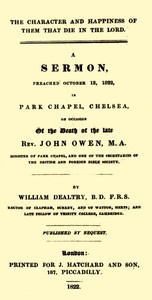
Before opening The Character and Happiness of Them That Die in the Lord A sermon, preached Oct. 13, 1822, in Park Chapel, Chelsea, on occasion of the death of the late Rev. John Owen — Background and Themes, the edition data offers a quick orientation: 13,087 words, 57 min estimated reading time, and 2 detected text sections.
The text analysis averages about 29.7 words per sentence, while the detected sections provide another way to judge how the source is divided.
Project Gutenberg metadata also associates the work with “Church of England -- Sermons,” connecting these edition facts with the source record’s subject description.
Explore this collection
These alternatives are selected using recorded categories and estimated reading time.
About 56 minutes
Theology
12,678 recorded words. 1 minutes difference from this book's estimate.
View Gutenberg source #62990About 55 minutes
Theology
12,571 recorded words. 2 minutes difference from this book's estimate.
View Gutenberg source #60592About 54 minutes
Theology
12,253 recorded words. 3 minutes difference from this book's estimate.
View Gutenberg source #25792Search stored excerpts and compare books → Choose by your preferences →
Choices use stored catalog measurements. Estimates vary with reading speed. A shared category is a catalog label, not a claim that two books have the same argument or literary quality.
Search reads excerpt text stored with this catalog and links to its associated Gutenberg record. The connection is stored in the site database; this tool does not recheck that every excerpt is word-for-word identical to that external record. Excerpt search does not cover every chapter and does not verify historical publication dates.
Catalog snapshot checked: 2026-09-25. Coverage: 94 public books, 94 available source excerpts.
Read the complete public-domain text at its original source.
Read on Project GutenbergThe sermon opens not with the deceased but with the apocalyptic machinery of Revelation: a Lamb on Mount Zion, a sealed multitude, and three angels bearing judgment and gospel. Dealtry dwells on the solemnity of the text's introduction before turning to John Owen. This structural choice—grounding personal loss in cosmic vision—shapes the entire address. The preacher moves from heavenly voice to earthly biography, using the scriptural frame to interpret Owen's life as a pattern of faithful labor.
Dealtry begins by parsing the Revelation passage with unusual care. He notes that the voice from heaven commands John to "Write"—a detail he emphasizes as a mark of infallible truth. The sermon's opening paragraphs trace the apocalyptic scene: the Lamb, the 144,000, the three angels. Only after establishing this celestial context does Dealtry introduce Owen. This movement from vision to particular death is deliberate. The preacher argues that the saints need patience amid conflict, and the voice offers encouragement. The structure mirrors the text's own abrupt proclamation: "I heard a voice from heaven."
The phrase "rest from their labours" governs the sermon's middle movement. Dealtry contrasts the turmoil of the age—persecution, Babylon's struggle—with the promised rest. He applies this to Owen not by listing achievements but by describing his deportment: "something in his character and deportment peculiarly suited to gain the affections of all that approached him." The preacher returns repeatedly to the image of labor and rest, weaving it through accounts of Owen's work with the British and Foreign Bible Society. The rhythm alternates between doctrinal exposition and biographical illustration, each reinforcing the other.
Dealtry extends Owen's influence across continents. He mentions the Continent, where Owen traveled and transmitted "interesting and important religious intelligence," and anticipates that foreign friends of the Bible Society will feel his loss. The sermon's geography is precise: Eastern and Western world, kindred Societies rising in rapid succession. Yet this global scope is balanced by intimate details—Owen's "unaffected humility," his habit of repeating "If God be for us, who can be against us?" The preacher insists that Owen's works follow him not as abstractions but as tangible effects in every region where the word has run.
When Dealtry asks where Owen's works are, he answers: "Where are they not?" But he immediately qualifies, noting that he does not detract from other laborers. The sermon includes a remarkable self-limitation: "Were I merely to transcribe their own recorded declarations, transmitted to me within the last few days, they would confirm the strongest statements." This gesture toward absent evidence—letters from colleagues—acknowledges the incompleteness of the spoken word. Dealtry also warns against neglecting personal religion amid public bustle, though he exempts Owen from that danger. The sermon thus balances eulogy with doctrinal caution.
Readers should attend to how Dealtry moves between the apocalyptic and the biographical. The sermon does not simply apply a text to a life; it lets the text's structure—voice, vision, command, promise—organize the memorial. The recurring images of rest, labor, and global expansion are not decorative but structural. Noticing how Dealtry handles the tension between public achievement and private faith will reward careful reading.
There’s something tender about how Dealtry eulogized John Owen—rest framed not as an ending but a quiet fulfillment. It made me think of the old Anglican tensions over fidelity, which Episcopal Fidelity — Edition Insights touches on with such care. Both whisper of earnest souls trying to hold faithfully amidst change, and I lingered on that thought longer than expected.
Build a private reading journal entry for this title.









