About 37 minutes
A Discourse for the Time, delivered January 4, 1852 in the First Congregational Unitarian Church — Story, Setting & Ideas
Theology
8,487 recorded words. 0 minutes difference from this book's estimate.
View Gutenberg source #31670
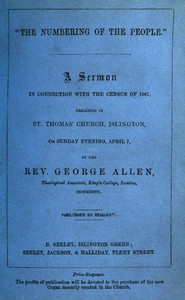
For "The Numbering of the People" A Sermon in conjunction with the census of 1861 preached in St. Thomas' Church, Islington, on Sunday Evening, April 7 — Context and Discussion, the stored edition analysis reports 8,375 words, 37 min estimated reading time, and 1 detected text section.
The text analysis averages about 22.4 words per sentence, while the detected sections provide another way to judge how the source is divided.
Project Gutenberg metadata also associates the work with “Sermons, English -- 19th century,” connecting these edition facts with the source record’s subject description.
Explore this collection
These alternatives are selected using recorded categories and estimated reading time.
About 37 minutes
Theology
8,487 recorded words. 0 minutes difference from this book's estimate.
View Gutenberg source #31670About 36 minutes
Theology
8,170 recorded words. 1 minutes difference from this book's estimate.
View Gutenberg source #20534About 38 minutes
Theology
8,641 recorded words. 1 minutes difference from this book's estimate.
View Gutenberg source #42331Search stored excerpts and compare books → Choose by your preferences →
Choices use stored catalog measurements. Estimates vary with reading speed. A shared category is a catalog label, not a claim that two books have the same argument or literary quality.
Search reads excerpt text stored with this catalog and links to its associated Gutenberg record. The connection is stored in the site database; this tool does not recheck that every excerpt is word-for-word identical to that external record. Excerpt search does not cover every chapter and does not verify historical publication dates.
Catalog snapshot checked: 2026-09-25. Coverage: 94 public books, 94 available source excerpts.
Read the complete public-domain text at its original source.
Read on Project GutenbergGeorge Allen's 1861 sermon, preached at St. Thomas' Church, Islington, directly engages with the contemporaneous national census. Rather than treating the census as a mere administrative event, Allen uses it as a springboard for spiritual reflection, drawing a parallel between the numbering of the Israelites in the wilderness of Sinai and the British enumeration. The sermon is explicitly occasional—published by request and printed exactly as delivered—yet it reveals a careful rhetorical strategy: Allen acknowledges the risk of letting 'temporal matters' dominate ministry but argues that such events can serve as 'vehicles for reminding men of spiritual and eternal verities.'
Allen's treatment of the census paper is strikingly personal. He contrasts the 1851 and 1861 returns, noting that 'names that were missing then, are found now'—referring to births, reunions, and prodigals returned. Yet he dwells more on loss: a head of household now 'sleeps in the silent tomb,' children are entered in a 'felon's prison house,' and prosperity has fled from mansion to garret. These observations are not abstract; they are grounded in the specific language of the census form, such as the instruction 'Write the name of the head of the family.' Allen uses the form's categories to evoke the fragility of earthly status and relationships.
A central tension in the sermon is the census paper's silence on religion. Allen notes pointedly that 'the omission of all reference to religion in that paper, is just the very point which I think may suggest a most important line of thought.' He refrains from condemning the state's secular approach, acknowledging practical difficulties and the risk of 'unfair returns' and 'angry passions.' Instead, he transforms the absence into a homiletic opportunity: the census counts bodies but not souls, prompting self-examination. 'These questions are not asked of me in the census paper,' he says, turning the listener's attention to spiritual accountability.
Allen concludes with a practical application tied to the sermon's setting. He declines to press for a formal collection but suggests that the census season is fitting for 'thank-offerings to God.' He directs congregants to offer gifts either at the church doors or through him for missionary work. This move ties the national event to local ecclesiastical life, reinforcing the sermon's dual focus on temporal and eternal. The reference to 'this tabernacle of God' echoes the wilderness tabernacle of the text, subtly linking the physical church building to the biblical narrative.
Allen's sermon is best read as a period piece that illuminates how Victorian clergy negotiated the intersection of state bureaucracy and pastoral care. Readers should note the careful balance he strikes: he neither sanctifies the census nor dismisses it, but uses its categories to provoke reflection on mortality, family, and faith. The sermon's brevity and occasional nature make it a focused example of mid-19th-century homiletics, rooted in a specific historical moment.
Reading that old sermon from Islington, with its gentle bewilderment at how the state counted souls without once asking about their spiritual state, I found myself recalling another quiet voice from a generation earlier — a vicar in Bradfield who, amidst the late disturbances, reminded his flock of the deeper peace found in order. It felt less like history than a shared, whispered conversation across the years. The Duty of Submission to Civil Authority, A Sermon Preached in the Parish Church of Bradfield, Berkes, on Sunday, November 28, 1830, on Occasion of the Late — Background and Themes carries that same longing for something steady beneath the surface of public life.
Your answers remain private and are stored only in this browser.









