About 38 minutes
Consecrated Womanhood A Sermon Preached in the First Congregational Church, Portland, Oregon — A Closer Reading
Theology
8,616 recorded words. 0 minutes difference from this book's estimate.
View Gutenberg source #49427
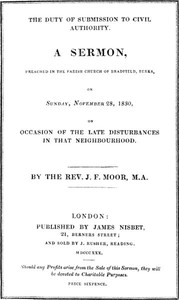
The Duty of Submission to Civil Authority, A Sermon Preached in the Parish Church of Bradfield, Berkes, on Sunday, November 28, 1830, on Occasion of the Late — Background and Themes can be approached with a clearer sense of reading commitment from its source measurements: 8,641 words, 38 min estimated reading time, and 1 detected text section.
The text analysis averages about 27.4 words per sentence, while the detected sections provide another way to judge how the source is divided.
Project Gutenberg metadata also associates the work with “Sermons, English -- 19th century,” connecting these edition facts with the source record’s subject description.
Explore this collection
These alternatives are selected using recorded categories and estimated reading time.
About 38 minutes
Theology
8,616 recorded words. 0 minutes difference from this book's estimate.
View Gutenberg source #49427About 37 minutes
Theology
8,487 recorded words. 1 minutes difference from this book's estimate.
View Gutenberg source #31670About 37 minutes
Theology
8,375 recorded words. 1 minutes difference from this book's estimate.
View Gutenberg source #64876Search stored excerpts and compare books → Choose by your preferences →
Choices use stored catalog measurements. Estimates vary with reading speed. A shared category is a catalog label, not a claim that two books have the same argument or literary quality.
Search reads excerpt text stored with this catalog and links to its associated Gutenberg record. The connection is stored in the site database; this tool does not recheck that every excerpt is word-for-word identical to that external record. Excerpt search does not cover every chapter and does not verify historical publication dates.
Catalog snapshot checked: 2026-09-25. Coverage: 94 public books, 94 available source excerpts.
Read the complete public-domain text at its original source.
Read on Project GutenbergThis sermon, preached on November 28, 1830, in Bradfield, Berkshire, responds directly to “the late disturbances in that neighbourhood.” The Rev. J. F. Moor takes as his text 1 Peter 2:13-14, which commands submission “to every ordinance of man for the Lord’s sake.” He immediately counters the charge that early Christians were rebellious, insisting that true religion makes “the best and most loyal subjects.” The sermon is explicitly derivative: Moor acknowledges his debt to Bishop Beveridge, whose “valuable and leading thoughts” he has “thrown into a new form.” Any profits from its sale were to go to charitable purposes.
Moor opens by refuting the accusation that Christians are “despisers of civil authority.” He argues that such a charge is a “false imputation” against Christianity. The apostles, he notes, consistently enforced submission to “the powers that be.” The sermon thus positions itself as a defense of Christianity’s political reliability, aimed at a congregation that had witnessed recent unrest. Moor’s language is emphatic: a man cannot be a Christian who “despiseth dominion, and speaketh evil of dignities.” He cites Jude to classify such people as “sensual, not having the Spirit.” This framing suggests that the disturbances were seen by some as arising from a lack of genuine faith.
The core of Moor’s argument is that Christian submission is not merely for fear of punishment (“wrath”) but “for conscience sake.” He develops this by describing how religion subdues “the unruly will” and regulates “the sinful affections of the heart.” The goal is that God may be glorified through the believer’s good works. Moor quotes Romans 13:5 to anchor this point: the Christian “must needs be subject not only for wrath but also for conscience sake.” This moves the duty from external compliance to an internal, spiritual obligation. The sermon repeatedly ties obedience to earthly rulers to the believer’s relationship with God.
In his concluding exhortation, Moor warns against “wicked and evil designing men” who would separate religion from submission to the king. He urges his hearers to “the law and to the testimony,” insisting that a man cannot be a faithful subject to his heavenly King and a traitor to his earthly king. Those dissatisfied with the government, he argues, have not been “humbled, enlightened, and sanctified by his Spirit.” Their religion is “false, and unscriptural, and vain.” Moor’s rhetoric escalates: the unhumbled face not just human penalties but divine judgment. He asks, “Can your hands be strong, or your hearts endure in the day when he shall deal with you?” This pastoral threat is the sermon’s sharpest edge.
Readers should note that this sermon is a specific historical artifact, shaped by the local context of the 1830 agricultural disturbances in southern England. Moor’s reliance on Bishop Beveridge and his explicit denial of originality make the text a window into how Anglican clergy adapted established theological arguments to immediate social crises. The sermon’s structure—defense, doctrinal exposition, then pointed application—follows a homiletic pattern common to the period. Those interested in the intersection of religion and political authority in early nineteenth-century England will find this a concise example of conservative clerical response to popular unrest.
Reading this old sermon, I felt the weight of a pastor trying to steady a frightened congregation, reminding them that order itself is a kind of mercy. It made me think of the quieter, more personal obedience explored in Women in white raiment — Inside the Classic, which I found myself re-reading later that same evening. Strange, how different texts can share that patient, searching quality.
Answer a few questions and save a private reflection on this device.









