About 63 minutes
The Religious Spirit of the Slavs Three Lectures Given in Lent, 1916 — Story, Setting & Ideas
Theology
14,386 recorded words. 1 minutes difference from this book's estimate.
View Gutenberg source #13388
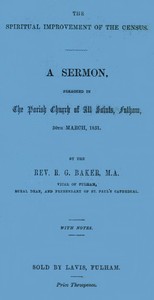
Before opening The Spiritual Improvement of the Census A Sermon, Preached in the Parish Church of All Saints, Fulham, 30th March, 1851 — A Reader’s Guide, the edition data offers a quick orientation: 14,146 words, 1 hr 2 min estimated reading time, and 2 detected text sections.
The text analysis averages about 28.4 words per sentence, while the detected sections provide another way to judge how the source is divided.
Project Gutenberg metadata also associates the work with “Church of England -- Sermons -- 19th century,” connecting these edition facts with the source record’s subject description.
Explore this collection
These alternatives are selected using recorded categories and estimated reading time.
About 63 minutes
Theology
14,386 recorded words. 1 minutes difference from this book's estimate.
View Gutenberg source #13388About 57 minutes
Theology
13,087 recorded words. 5 minutes difference from this book's estimate.
View Gutenberg source #67064About 56 minutes
Theology
12,678 recorded words. 6 minutes difference from this book's estimate.
View Gutenberg source #62990Search stored excerpts and compare books → Choose by your preferences →
Choices use stored catalog measurements. Estimates vary with reading speed. A shared category is a catalog label, not a claim that two books have the same argument or literary quality.
Search reads excerpt text stored with this catalog and links to its associated Gutenberg record. The connection is stored in the site database; this tool does not recheck that every excerpt is word-for-word identical to that external record. Excerpt search does not cover every chapter and does not verify historical publication dates.
Catalog snapshot checked: 2026-09-25. Coverage: 94 public books, 94 available source excerpts.
Read the complete public-domain text at its original source.
Read on Project GutenbergRobert George Baker, vicar of Fulham, preached this sermon on 30 March 1851, the day the national census was taken. He takes as his text 2 Samuel xxiv. 10, where David’s heart smites him after he numbers the people. Baker uses the parallel to argue that the census, though a civil duty, risks the same spiritual error: trusting in numbers rather than in God. The sermon moves from David’s early reliance on divine strength—the lion, the bear, Goliath—to his later pride in the size of his kingdom. Baker’s voice is that of a learned clergyman, weaving scriptural narrative with contemporary application, but the appended notes shift sharply into controversial theology, quoting Catholic tracts at length to refute them.
Baker opens by contrasting David’s youthful faith with his later presumption. He recalls how David, as a boy, faced “a lion and a bear” and later Goliath, trusting not in armour but in the Lord. The sermon dwells on the irony that the same man who “prevailed with a sling and with a stone” later succumbed to the temptation of counting his subjects. Baker’s language is precise: David was “proud of the extent of his dominions and of the multitude of his subjects,” and “secretly pleased with the proof it would afford to other nations.” The census becomes a type of spiritual failure—a reliance on the “arm of flesh.” Baker does not condemn the 1851 census outright but warns his congregation that any numbering of people, if done without humility, repeats David’s sin.
The sermon itself is tightly constructed: a scriptural exposition followed by moral application. Baker’s sentences are long and periodic, building a rhythm of warning. He uses repetition of key phrases—“the lion and the bear,” “the arm of flesh”—to drive his point home. The pace is deliberate, almost judicial, as he lays out David’s history and its lesson. However, the appended notes abruptly change both tone and tempo. They consist of extended extracts from Catholic tracts, each followed by Baker’s rebuttal. The voice shifts from pastoral to polemical, and the prose becomes more direct, even combative. For example, he quotes a Catholic writer who claims that Protestants misuse “Search the Scriptures,” then counters with arguments about apostolic authority. This structural break—from sermon to disputation—marks a distinct change in the work’s intended audience and purpose.
The notes occupy roughly half the text and are drawn from tracts such as The Church, the Guardian of Scripture and The Rosary of the Blessed Virgin Mary. Baker reproduces passages that defend Catholic practices—repetitive prayer, devotion to Mary, the authority of unwritten tradition—and then refutes them point by point. His method is to let the Catholic text speak first, then to answer it with scriptural and historical arguments. For instance, he quotes a claim that the apostles taught unwritten doctrines, and responds by insisting that “the only sure way of knowing God’s will is for every man to read the Holy Scriptures for himself.” The tone is urgent, even alarmed, as if Baker sees the 1851 census as a moment when national identity and religious allegiance are at stake. These notes reveal a preacher engaged in a broader cultural battle over the nature of Christian authority.
Readers should approach this sermon as a document of its time—a snapshot of mid-Victorian Anglican anxiety about both state power and Catholic influence. The census provides the occasion, but the real subject is trust: in God, in scripture, and in the nation. Baker’s voice is earnest and learned, but the appended notes show a preacher willing to engage directly with opposing views. For those interested in Victorian religious rhetoric, this text offers a compact example of how a public event could be turned into a spiritual lesson, and how that lesson could quickly become a polemic.
That rainy afternoon, the sermon’s sharp-edged pride felt oddly calming, like watching distant lightning. Later, idly, I found myself reaching for Natural Law in the Spiritual World — Context and Discussion, and the same quiet geometry of trust versus self-assertion seemed to echo there, softer, without the polemic’s heat.
Answer a few questions and save a private reflection on this device.









